Executive Summary
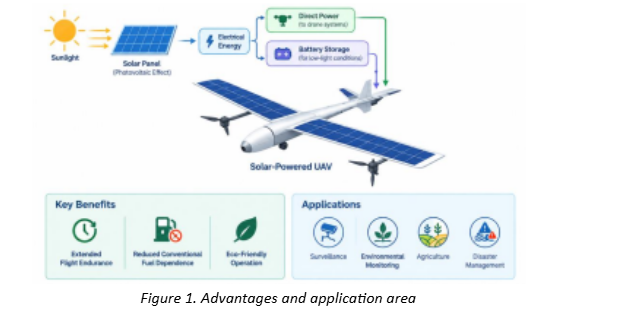
A solar-powered drone is an unmanned aerial vehicle (UAV) that utilizes solar energy for flight operations. Solar panels convert sunlight into electrical energy through the photovoltaic effect, which can either power the UAV directly or be stored in a rechargeable battery for use during low-light conditions. The integrated power management, flight control, propulsion, and sensing systems enable efficient and stable operation of the UAV. This whitepaper presents the working of solar-powered drones, components, mechanism, technical advantages, current research developments, intellectual property landscape, market outlook, and future opportunities for widespread deployment. .
1. Introduction
A solar powered drone is an advanced unmanned aerial vehicle (UAV) that uses solar energy as its primary power source to achieve longer and more efficient flight. It is equipped with solar panels that convert sunlight into electrical energy through the Photovoltaic Effect, which is then either used directly or stored in a rechargeable battery for continuous operation. Unlike traditional drones that depend only on battery power, solar powered drones can operate for extended periods with reduced need for frequent recharging. These drones integrate key components such as a flight controller, sensors, motors, and power management systems to ensure stable flight, navigation, and efficient energy usage. With the growing need for sustainable and eco-friendly technologies, solar powered drones are widely used in applications like surveillance, environmental monitoring, agriculture, and disaster management, making them an important development in modern drone technology.
2. Purposed Solution: Technology Overview
2.1 What are Solar-Powered Drones?
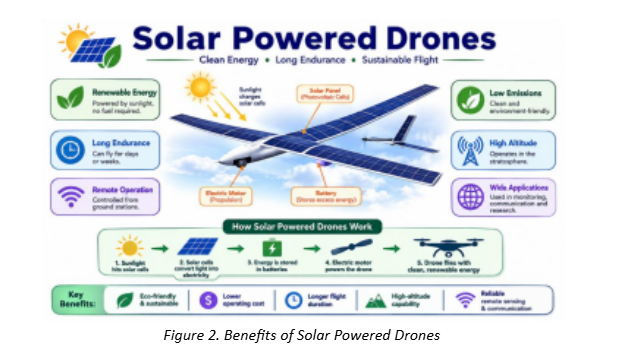
Solar UAVs, also known as solar drones, represent an unprecedented innovation in unmanned aerial vehicle technology. These autonomous vehicles are powered by solar energy, giving them the unique ability to fly for long periods of time without recharging their batteries. This feature makes them ideal tools for a wide range of applications, from environmental monitoring and infrastructure surveillance to search and rescue operations. Solar-powered drones often feature lightweight designs and advanced energy management systems to optimize power utilization and improve performance.
The Solar-Powered Drone may also be called: Solar UAV (Unmanned Aerial Vehicle), Sun-powered drone, Solar aircraft, Solar-powered UAV, Solar-powered quadcopter, Solar energy drone, Solar electric drone, Solar flyer, Solar-powered aerial vehicle, and Solar-powered unmanned aircraft.
2.2 How Solar Drones Works
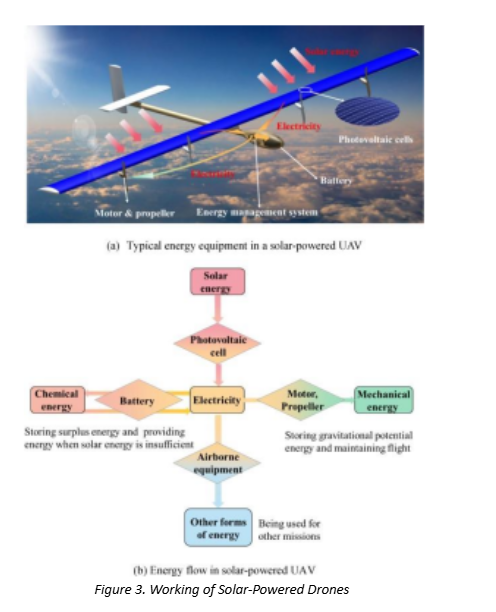
Solar-powered UAVs use photovoltaic cells installed over a substantial portion of the aircraft's wing surface. The cells capture solar radiation and generate electrical power. The captured solar energy is converted into electrical energy that can be supplied to the aircraft's propulsion system and onboard equipment. The generated electricity powers the drone's electric motors. The electric motors drive the aircraft's propulsion system, allowing the UAV to maintain flight. During periods when solar energy is available, the system can store energy in rechargeable batteries. At night or during dark, stored battery energy can be used to continue operating the aircraft. The combination of solar generation, electric propulsion and energy storage allows solar-powered UAVs to remain airborne for substantially longer periods than conventional battery-only systems.
2.3 Components
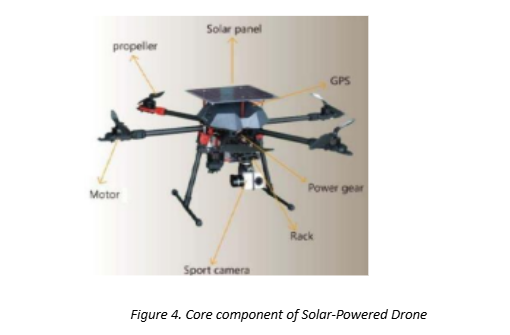
Main component of Solar-Powered Drone, at the forefront of sustainable architecture, comprises:
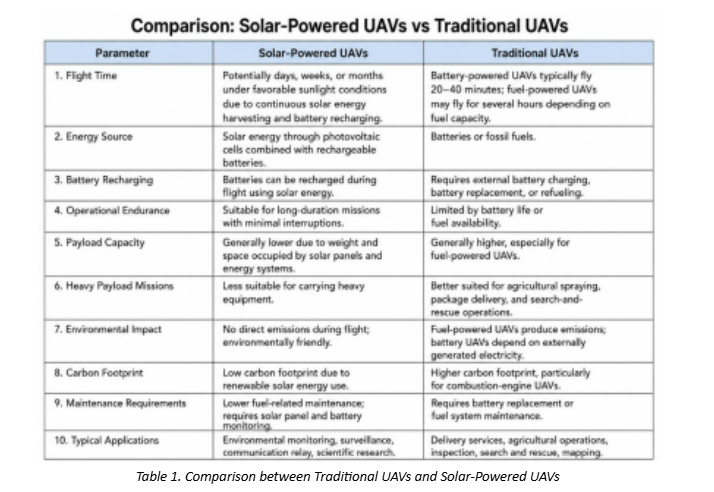
2.4 Quantitative Comparisons
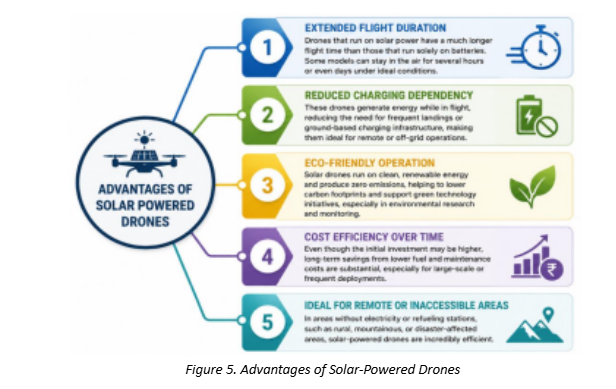
3. Advantages of Solar-Powered Drones
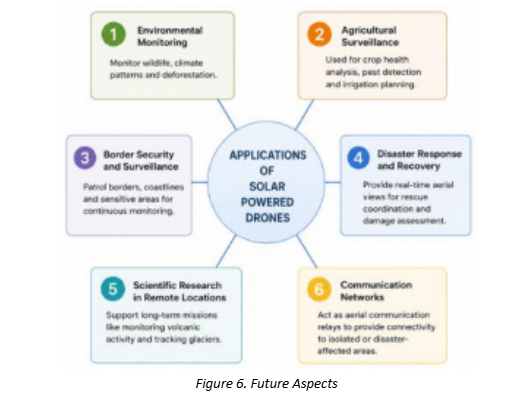
4. Applications Area & future Aspect
Advancements in nanomaterial and perovskite research are expected to raise efficiency and lower costs. Also, Integration with smart building systems will optimize energy management as well as widespread deployment could transform urban infrastructure into net energy producers.
5. IP Activity in Solar-Powered Drones
As part of our analysis of patent activity in Solar-Powered Drones, an IP study was conducted to identify patents related to this technology and a total of 710 patent families out of 1975 were selected for final analysis.
5.1 Relevant keywords, synonyms and classes used for search
- Solar powered drone, Solar powered UAV, Photovoltaic UAV
- Solar panel, Solar array, Solar cell, Solar module, Photovoltaic panel, Photovoltaic array, Photovoltaic cell, Photovoltaic module
- Energy storage, Battery system, Energy management
- Electric motor, Electric propulsion
- Autonomous navigation, Flight control
- Relevant patent classification includes B64U2101/00, B64U2101/10, B64U80/82, B64U50/31 and B64U50/13
5.2 Graphical Analysis from the identified patents (710 patent families):
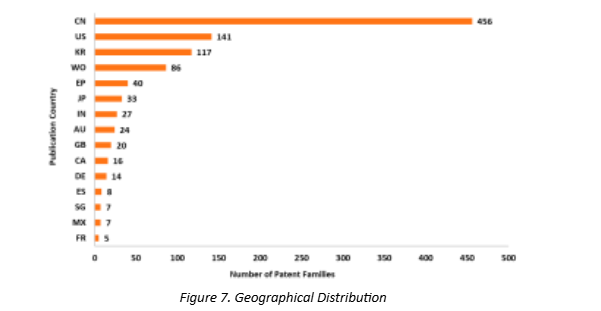
Figure 7 shows the distribution of patents across priority countries, providing insight into major R&D locations for solar-powered drones; China has most patents i.e., 456, followed by US with 141 patents and Korea with 117 patents.
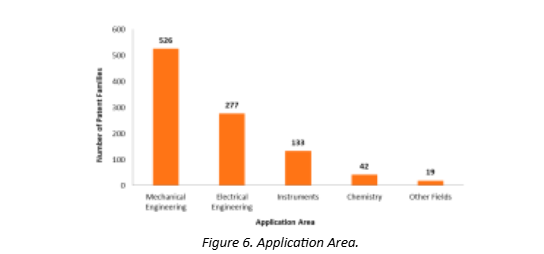
Figure 6 shows the application area of solar-powered drones with a major focus on Mechanical engineering with 526 patent families, since PV cell weight balancing and positioning plays crucial role in this domain. Electrical Engineering hold at second place, with 277 patents family.
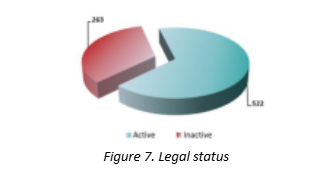
Figure 7 shows a pie chart demonstrating the total number of active and inactive patents, with 522 patents categorized as “Active" and 263 as “Inactive".
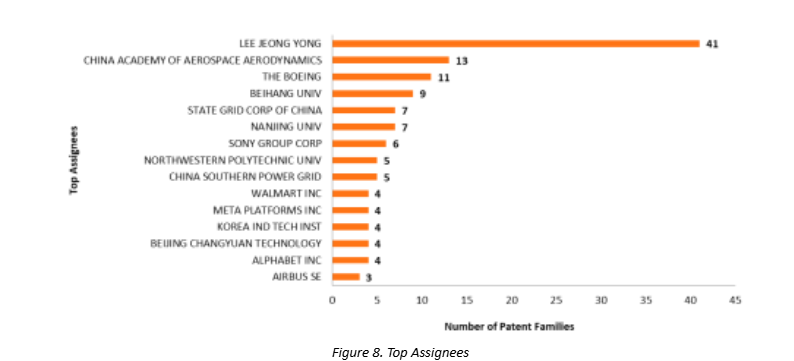
Figure 8 Shows top patent assignees, with the Lee Jeong Yong leading with 41 patents, followed by the China Academy of Aerospace Aerodynamics with 13 patents with focus on advanced solar-UAV configurations, including tilt-wing and VTOL architectures.
6. Market and Commercial Outlook
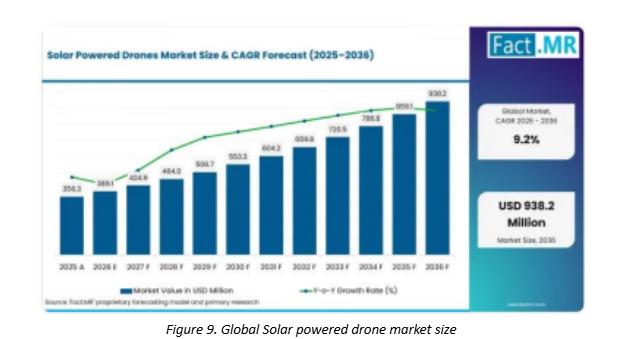
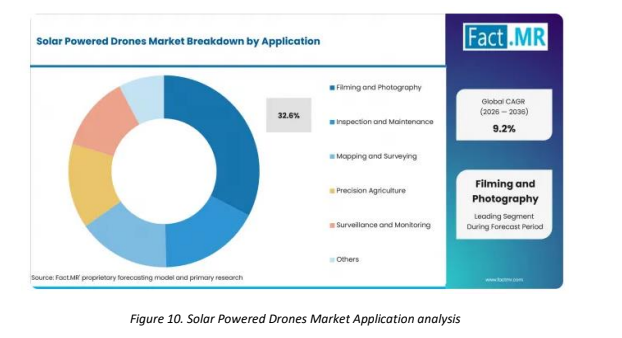
Solar powered drone Market Size: The Solar Powered Drones Market was valued at USD 356.3 million in 2025. Demand is projected to increase from USD 389.1 million in 2026 to USD 938.2 million by 2036. The market is forecast to record a 9.2% CAGR from 2026 to 2036 as fixed wing platforms, filming users and farm operators adopt longer daylight missions.
Filming and photography leads Application as aerial content teams value predictable daylight operation. Aerial photography, cinematography and media coverage benefit from platforms that reduce battery-led pauses during outdoor shoots. Inspection and maintenance, mapping and surveying, precision agriculture and surveillance applications widen the base beyond content creation.
7. Conclusion
Solar powered drones provide an intelligent, future-ready option for long-endurance aerial operations as efficiency and sustainability become top concerns across industries. These drones are perfect for everything from agriculture and research to surveillance and disaster response because they use renewable energy to lower operating costs, increase flight durations, and lessen their environmental impact.
In conclusion, the development of a solar-powered drone represents a significant advancement in unmanned aerial vehicle (UAV) technology, offering numerous benefits in terms of sustainability, extended flight time, and versatility. By integrating solar panels and optimizing energy efficiency, solar drones have the potential to revolutionize various industries and applications.
Their ability to leverage solar energy not only extends their flight times but also reduces their environmental footprint, marking a significant step towards sustainable aviation. As technology continues to evolve, the efficiency and capabilities of solar drones are expected to further improve, opening up new possibilities for applications in surveillance, agriculture, disaster response, and beyond. With continued research, development, and regulatory support, solar drones are poised to become indispensable tools for addressing a wide range of challenges while contributing to a more sustainable future.
How Pitch Scientific Supports Innovation in Solar-Powered Drones
Pitch Scientific brings expertise in advanced UAV technologies, renewable energy integration, power electronics, lightweight materials, and intelligent control systems, supporting the development of efficient and long- endurance solar-powered aerial platforms. Our expertise includes:
Solar Energy & Power Integration: Understanding of photovoltaic energy harvesting, energy management, battery integration, and power optimization for reliable UAV operation.
Lightweight Design & Performance Optimization: Expertise in lightweight materials, aerodynamic considerations, thermal management, and system-level optimization to improve flight efficiency and endurance.
Intelligent Control & System Integration: Knowledge of flight control, sensor integration, navigation, and intelligent power management for stable, efficient, and autonomous UAV operation.
Pitch Scientific supports clients in developing strong IP portfolios and commercialization strategies for next- generation solar-powered UAV technologies, enabling innovation protection, competitive differentiation, and scalable solutions.


