Executive Summary
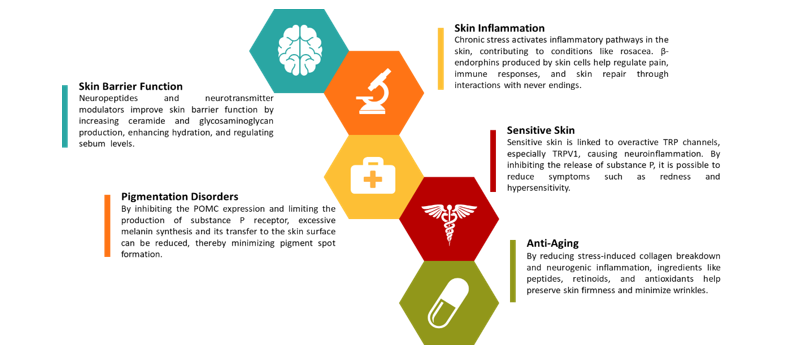
Neurocosmetics is an emerging field that works with the skin’s nervous system to improve both appearance and emotional well-being. Unlike traditional cosmetics, neurocosmetics use ingredients like neuropeptides, adaptogens, and cannabinoid receptor agonists to reduce stress, inflammation, and signs of aging. These products support skin balance, barrier function, and hydration, and are used for treating sensitive skin, pigmentation, and inflammation. As the field grows, safety and regulations remain important, while neurocosmetics continue to redefine skincare by focusing on both visible improvement and overall well-being.
Neurocosmetics not only improve how the skin looks but also influence how it feels by helping in modulating stress, inflammation, or even muscle tension. As more people look for skincare that supports both appearance and overall well-being, neurocosmetics open new possibilities.
1. Introduction
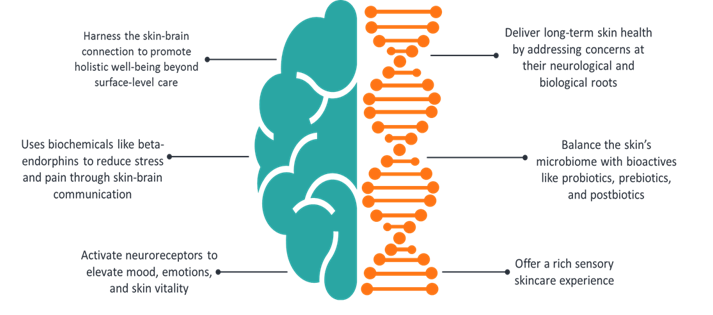
Our skin serves as a protective barrier and is an important body part in regulating bodily functions and well-being. Recent research has shown that the skin is a source of neurotransmitters, hormones, and peptides. Skin cells like keratinocytes, fibroblasts, and melanocytes are all involved in this process, which help the skin to respond to both internal and external changes. This discovery has led to the development of neurocosmetics, a new approach to skincare that focuses on the connection between the brain and the skin also called the skin-brain axis.
Neurocosmetics not only improve how the skin looks but also influence how it feels by helping in modulating stress, inflammation, or even muscle tension. As more people look for skincare that supports both appearance and overall well-being, neurocosmetics open new possibilities.
2. Neurocosmetics vs. Traditional Skincare Products
3. Stress and Skin: Cortisol’s Impact and Neurocosmetic Solutions
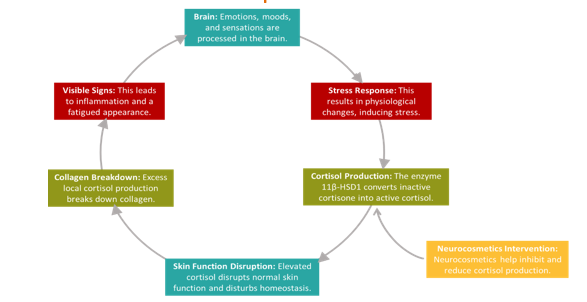
The skin has a range of neurotransmitter receptors and neuromediators like serotonin, dopamine, corticotropin-releasing hormone, substance P, and β-endorphins. These molecules are found in the nerve endings of the skin and are also produced by cells such as keratinocytes, melanocytes, and immune cells suggesting a locally controlled neuroendocrine system within the skin itself. Applying certain compounds topically like peptides that act as acetylcholine antagonists for example, acetyl hexapeptide-8 or ingredients that elevate β-endorphin production, has been shown to reduce stress-induced skin sensitivity and muscle tension, leading to visible improvements and a sense of psychological comfort.
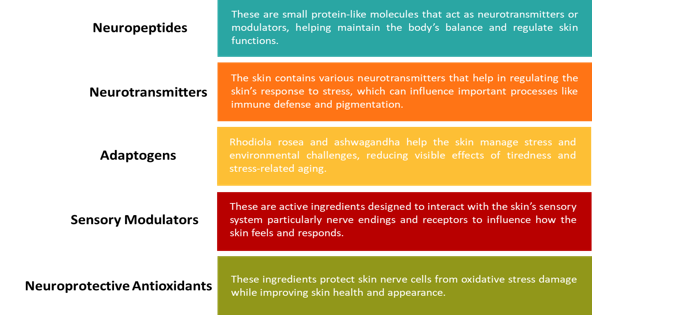
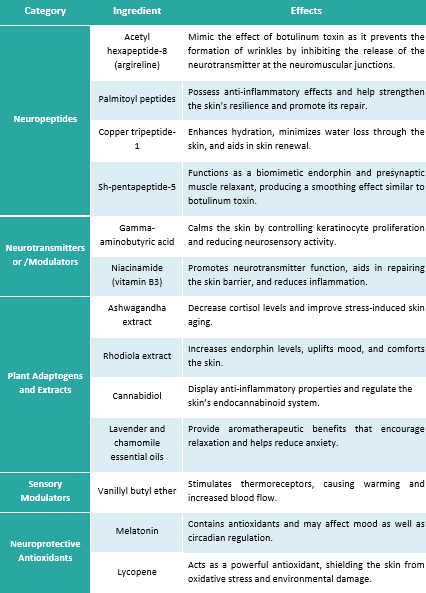
4. Active Ingredients commonly used in Neurocosmetic Formulations
5. Skin Health Challenges and Neurocosmetic Solutions
6. IP Activity in Plasma-Activated Liquids
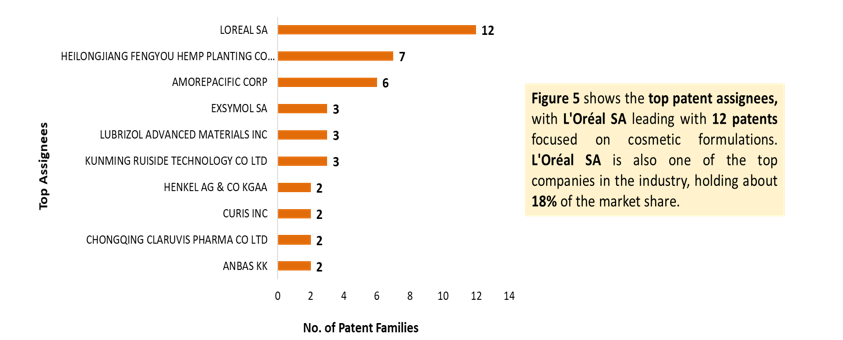
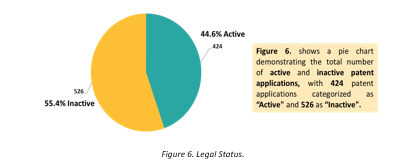
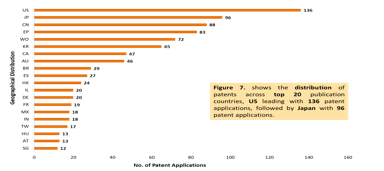
The IP data on neurocosmetics reveals various trends, highlighting geographical distribution, legal status, and key assignees. A total of 150 patent families, comprising 950 patent applications provide the following insights.
6.1 Relevant keywords, synonyms and classes used for search
- Neurocosmetics, Brain-Skin Axis Care, Mind-Beauty Skincare, Sensory Cosmetics, Sensorial cosmetics
- Neuropeptides, neurochemicals, Neurotransmitters, Neuro-modulators, Plant Adaptogens, Plant Extracts, Sensory Modulators, Neuro-sensory modulators, Neuroprotective Antioxidants
- Relevant patent classification includes A61Q19/00, A61Q17/04, A61Q19/08, A61P17/00, A61K2800/10, A61Q19/005, A61K8/9789, A61K2300/00, A61K2800/74, A01H5/12
6.2 Graphical Analysis from the identified patents:
Listed are the area where the industry 5.0 may implemented and play a vital role under human control:
7. Market and Commercial Outlook
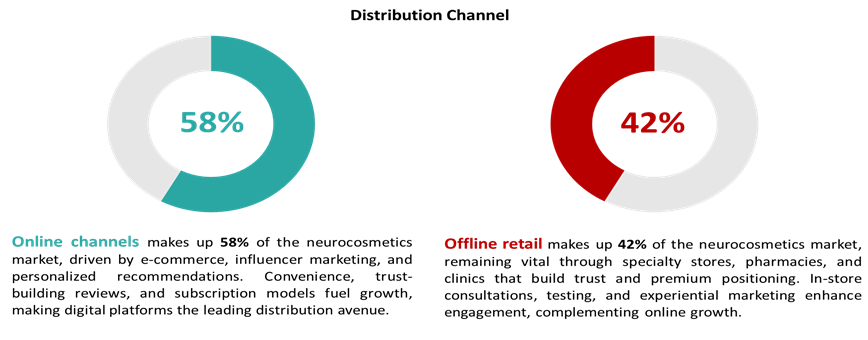
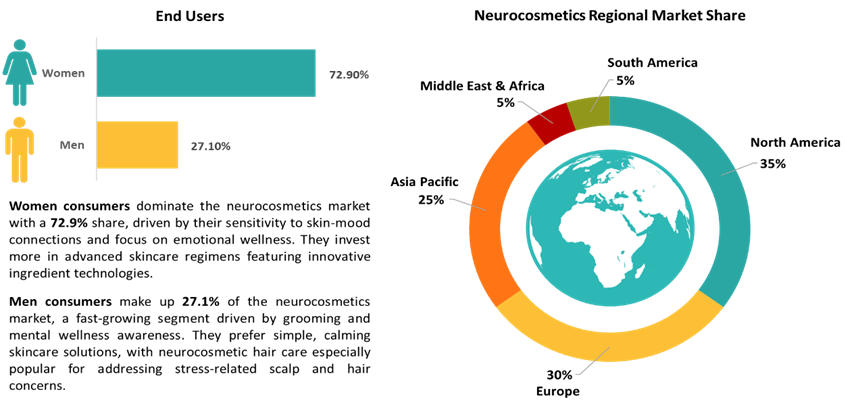
The global neurocosmetics market was valued at USD 2.14 billion in 2025 and is expected to grow from USD 2.32 billion in 2026 to USD 4.5 billion by 2034, exhibiting a CAGR of 8.61%.
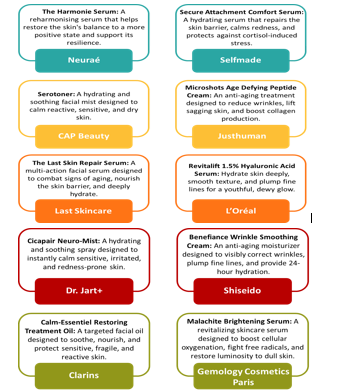
Neurocosmetic Brands & Their Best Selling Products
9. Safety and Regulatory Considerations
Neuroactive compounds such as peptides and neurotransmitter modulators may penetrate the skin and enter systemic circulation, posing potential risks. Standardized in vitro and in vivo testing methods, including advanced 3D skin models with sensory neurons, are essential to assess absorption and off-target exposure. Long-term use of neurocosmetic products may disrupt skin balance, potentially causing desensitization, inflammation, or sensitization. Therefore, extended safety evaluations are necessary.
In the European Union, products affecting skin nerves may be regulated as medicinal items, requiring extensive safety and efficacy data. In contrast, the U.S. treats them as cosmetics unless therapeutic claims are made. This creates a regulatory gray area, especially for products targeting neural pathways for anti-aging, pigmentation, or sensitive skin relief.
10. Future Outlook
As neurocosmetics continue to gain attention, future efforts must focus on transforming current scientific concepts into well validated clinical applications. Involving creating standardized testing protocols to assess the impact of neuroactive topicals on skin neuromediator levels and psychological well-being. Long-term studies integrating both dermatological and emotional outcomes using tools like psychometric assessments will be the key to establishing their efficacy.
The neurocosmetics market is expected to expand, offering innovative products that bridge the gap between skin health and emotional balance. Future innovations are likely to emphasize customized solutions that promote both visible skin improvements and inner well-being, making neurocosmetics a key part of treating both the skin and overall well-being together.
11. Conclusion
Neurocosmetics mark a promising shift in skincare by addressing the complex communication between the skin and nervous system. By targeting neurochemical pathways, these products go beyond surface-level care to promote long lasting skin health and emotional balance. While challenges around safety and regulation remain, the growing scientific understanding and consumer interest suggest neurocosmetics will play a vital role in the future of skincare, offering more effective and holistic solutions for a wide range of skin concerns.
How Pitch Scientific Supports Innovation in Neurocosmetics
Pitch Scientific brings deep domain expertise in Neurocosmetics, grounded in a strong understanding of cosmetic products. Our experience spans the development, characterization, and biological evaluation of neurocosmetic formulations across sensitive skin, pigmentation, barrier function, anti- aging, and inflammation use cases. Our expertise includes:
Understanding the importance of skin-nervous system interactions, sensory pathways, and the underlying mechanism of how neurocosmetics work.
Expertise in the active ingredients used, their mechanisms of action, and their stability within formulations.
Insight into neurocosmetic-mediated modulation of skin sensitivity, pigmentation balance, barrier reinforcement, and anti-inflammatory pathways.
IP Trends, Market, and Commercial Outlook: Knowledge of patent activity, market patterns, and the commercial potential of neurocosmetic products.
With this focused scientific expertise, Pitch Scientific supports informed decision-making around Neurocosmetics.
References
- https://www.sciencedirect.com/science/article/pii/S0738081X25001427
- https://www.mdpi.com/2079-9284/8/3/66
- https://www.researchgate.net/publication/389915964_NEUROCOSMETICS_AN_EXTENSIVE_OVE RVIEW
- https://www.iebrain.com/neurocosmetics-transforming-beauty-through-the-power-of-neuroscience/
- https://tks-hpc.h5mag.com/hpc_today_2_2024/neurocosmetics_-_beauty_and_the_brain_how_the_nervous_system_shapes_neurocosmetic_innovations
- https://fclskincare.com/blogs/blog/all-you-need-to-know-about-neurocosmetics?srsltid=AfmBOooUuSUdYBKKPWo3EYXTuYOw5c_ahacKRCoircwjOSbLE0fPZWTF
- https://justhuman.co.in/blogs/articles/neurocosmetics-products-vs-traditional-skincare-products?srsltid=AfmBOoqXoBK3UobG63tC96CmZEti2XGZEdTJ80WsxnYx4EMmF0iM-Su9
- https://pubmed.ncbi.nlm.nih.gov/12503615/
- https://en.neurocosmetics.eu/?gad_source=1&...
- https://www.benthamdirect.com/content/journals/cosci/10.2174/0126667797354459250204052908
- https://ameorganic.com/blogs/skin-care-blogs/neurocosmetics-vs-traditional-skincare- understanding-the-shift-in-beauty-trends?...
- https://www.fortunebusinessinsights.com/neurocosmetics-market-112777
- https://www.datainsightsmarket.com/reports/neurocosmetics-429038
- https://www.news.market.us/neurocosmetics-market-news/
- https://pocketbeautyedit.com/neurocosmetics-brands/
- https://www.makeupbrands.org/neurocosmetics-makeup-brands/
About Pitch Scientific
Pitch Scientific is a patent research and analytics firm that supports innovation across science, technology and intellectual property. We work closely with research teams, IP professionals and decision-makers to help them navigate complex technical and patent landscapes with clarity and confidence.
With strong experience in patent analytics, prior art research and technology intelligence, Pitch Scientific works with start-ups, research-driven organizations, corporations and law firms across a wide range of technology areas. Our team brings together scientific understanding and practical IP knowledge to deliver insights that are clear, reliable and directly relevant to client needs.
We place emphasis on sound methodologies, flexibility and consistent quality in our work. By focusing on accuracy, transparency and continuous learning, Pitch Scientific strives to create lasting value for clients and the innovations they develop.
Our Capabilities
- Knock Out Search
- Patentability Search
- Freedom to Operate Search
- Invalidation Search
- Patent Infringement Search
- Evidence of Use/Claim Charts
- Evidence of Use/Claim Charts
- Patent Portfolio Analysis
- Literature Watch
- Patent & Technology Landscape
- Technology Scouting
- Technology Scouting
- Market Research